by Julie Erdelyi
What do greetings really do for us? They are a social convention we expect, but one that has become so routine—a head nod, a single word—that I wonder why we keep using them. Of course greetings are a social courtesy we extend to others, but they have the potential to be so much more.
I teach children who have autism. The experiences with my students have shown me how important a greeting can be when it rises above the ordinary. It’s then that the greetings become an acknowledgement that we are thought about and cared about by others. Let me tell you what I mean.
First there was Jackie, a teenage girl with Retts Syndrome, who would rock and smile and yell enthusiastically when I said hello to her. Here she was, unable to walk, unable to speak and she was so happy to see me. I thought, “I have got to lighten up! There is not a single challenge I face that comes anywhere close to what Jackie copes with every day and she is smiling at me.”
by Suzanne Loring
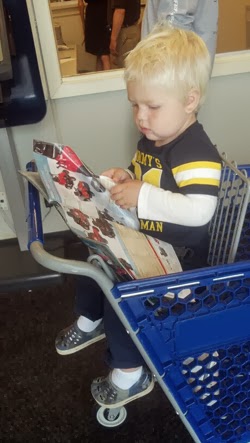
Bedtime stories are a long-standing family tradition in my family. Growing up I was read to every night before bed, a chapter here, a story there, and now do the same for my two boys who are two-and-a-half and nine months old. Each night after brushing his teeth, my two-year-old picks a book off his bookshelf and the three of us hunker down in one of the big bean bag chairs we have sitting on the floor. Even though my oldest climbs around during the story and my youngest usually tries to eat the book, we have a great time making truck noises, turning the pages, and pointing out funny things in the pictures. It’s important to me that we are carrying on a family tradition and having a lot of fun together, with books, every night before bed.
Creating a daily reading routine with your child is more than just fun; it helps build vocabulary and listening skills, develops your child’s imagination, and encourages a love of reading. It also creates quality time between reader and listener and can be a wonderful conversation starter. And in thinking about your child’s future a 2007 study by The National Endowment for the Arts, To Read or Not to Read: A Question of National Consequence, found that children who read for enjoyment score higher on reading and writing tests and have greater success later in life. Talk about a win-win-win situation.
by Jenna Bisset
The source of a parent’s pride in
their child can come from surprising places filled with tiny actions that speak
to a deeper sense of self-confidence. A deep breath taken to calm themselves
down, an outfit that almost matches
put on alone and with enthusiasm, a song sung in their soft, melodic voice or a
simple look given that tells you there are a million reasons to be proud. You
never know when the next moment will occur that gives you pause and allows you
to bask in your child’s accomplishments, but you know it will be delightful.
My most recent experience like this
was with my three year old at our dinner table. We play a game or do an
activity most nights after eating; on this night our activity was a number
mosaic in which you attach the appropriate color to the appropriate number to
create an underwater world. I pointed to 14 and asked my daughter if she knew
this number as we had recently started working on double digits. After a
thoughtful pause, she stated simply, “I don’t know.” And herein lies one of my
proudest moments to date as a parent.
by Ed Wilkens
Depending on family dynamics, you might become aware of any academic difficulties your child is experiencing over family dinner, while driving to soccer practice or in those quiet conversations just before bed. Or, you might be totally surprised to learn from your child's teacher or through a formal written progress report that things are not going as well as you had assumed.
Regardless of how you discover the challenges, what you do next is crucial and it's all about communication and relationships. The essential players include you, your child and the teacher or teachers relevant to the challenge. Potential additional partners might include a counselor, coach or administrator depending on the specifics of the challenge.
by Laurie Caswell Burke
As I observe
the hustle and bustle of the holiday season, I sometimes marvel at how frantic
people allow themselves to get. They rush around at warp speed trying to find
the perfect gift, make all the cookies, buy the tree, trim the tree and pen
holiday cards. For me, the holidays have always offered a chance for
reflection. I make an effort to not get caught up in the hubbub, and instead
make time for friends and family any time they want to see me.
I notice more
and more that the line after Thanksgiving is often, "We should get
together after the holidays." That seems ironic—isn’t getting together
with good friends and being grateful for family what the spirit of the holidays
is all about? Each year, my husband Tim and I try to take time to look back on
the year and remember all the things that we have to be thankful for.
Our daughters
Kate and Molly are always quick to come to mind. And we will be eternally
grateful for the Stern Center and the role it has played in helping them both achieve
their accomplishments.
by Laurie Caswell Burke
 Distractions have crept their way into our lifestyles for
better or for worse. And as great as
they are in connecting us with the world at large they can present challenges
when it comes to study habits for our teen population. Would you rather come home from school and
tune into myriad of distractions, tackle
the stack of books facing you, do a few physics
problems, or write that English essay?
Because of the widespread use of electronics which can become very
addicting, it is important to develop good study habits early on. These will
transfer to good work habits as our teens enter the employment arena.
Distractions have crept their way into our lifestyles for
better or for worse. And as great as
they are in connecting us with the world at large they can present challenges
when it comes to study habits for our teen population. Would you rather come home from school and
tune into myriad of distractions, tackle
the stack of books facing you, do a few physics
problems, or write that English essay?
Because of the widespread use of electronics which can become very
addicting, it is important to develop good study habits early on. These will
transfer to good work habits as our teens enter the employment arena.
by Dr. Blanche Podhajski
I did not blog last month because December was a blur. I was away
with family for the holidays and, like everyone, my thoughts were
preoccupied with the tragic events in Sandy Hook. Our hearts go out to
the families and survivors whose memories are forever changed. Those of
us who work in schools and clinics know what little six and seven year
old children are like in December. Their exuberance and joy are
palpable. Their loss deprives us all. May we honor their memory by
being inspired to help all children as did the courageous teachers of
Sandy Hook. Educators deserve such admiration and respect for the
responsibilities they assume every day to advance the knowledge,
preserve the safety, and sustain the self-esteem of our young.
One of the gifts I received for Christmas was Far from the Tree: Parents, Children and the Search for Identity
by Andrew Solomon. It is a 700 page tome but written with such
sensitivity and beautiful language that you don’t realize how much you
have read. You can bop around the book and read the chapters of high
interest first but may be surprised by those you didn’t expect to relate
to and do. The stories shared are particularly compelling. What
resonated for me was the responsibility all of us have when using
language.
by Dr. Blanche Podhajski
It’s happened to me twice now. Both in September and November, as my
husband and I are flying home from visiting family, he takes his nose
out of the newspaper and says to me: “you’ve got to read this.” I love
when he does this because the two articles he shared really gave me
food for thought. Both articles were from the Wall Street Journal
weekend edition.
In September, “Opting Out of the ‘Rug Rat Race’” was Paul Tough’s adaptation of his new book How Children Succeed: Grit, Curiosity and the Hidden Power of Character. Tough
contends that parents are overly concerned about their preschool
children’s intellectual skill set, what he calls the “cognitive
hypothesis.” Rather, Tough says what matters most in young children’s
development is a totally different set of qualities such as persistence,
self-control, curiosity, conscientiousness, grit and self-confidence.
Tough cites a study conducted with GED recipients who, while
demonstrating the same knowledge and skills as high school graduates,
did not have the same positive outcomes in life because they lacked the
essential ‘non-cognitive” skills. I surely agree with Tough that
motivation and perseverance are essential, as are the qualities that
contribute to character. I happily bought the book.