Showing posts with label Research. Show all posts

Thursday, July 3, 2014

10 Reasons to Keep Reading Aloud to Your Toddlers Even When They Prefer to Climb on Your Head


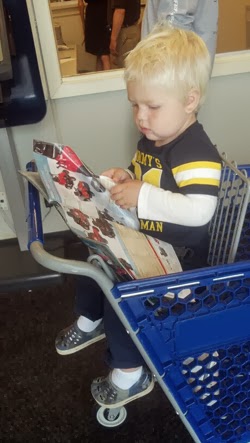
Do you get frustrated while reading aloud with your toddler? You pick out the perfect book. You get your child all comfortable on your lap. After one, maybe two, pages your little one tries to eat the book, hops off your lap and starts playing with a different toy, starts climbing all over you and in general seems completely uninterested in the story you are reading?

Don’t get discouraged.

Don’t stop reading.

This is all completely normal.

Your child is still listening and learning.
 

Reading with your child, young or old, on a daily basis is one of the best ways to ensure your child's future success in school and later in life. Here are 10 reasons why:

1. Eighty percent of a child’s brain is developed by the time s/he is three years old. Reading to young children stimulates brain development, improves listening skills and builds vocabulary.

2. Toddlers learn that there is a front and a back to the book. They also learn how to hold a book and how to turn its pages.

3. Reading nursery rhymes and singing songs spark children’s awareness of language and sounds.

Tuesday, January 21, 2014

President's Message: Getting Organized in 2014

by Blanche Podhajski
 
freeimages.co.uk
So the new year is getting older by the day.  How are you doing with your resolutions? Apparently, only 45% of us make them and only 8 % of us keep them (statisticbrain.com) so maybe the question is moot. I was thinking the other day about what might be among the most popular resolutions. For sure I thought “getting organized” would be right up there but it didn’t make the top ten. Not that I would have realized that by the numbers of organizational aids for sale.  

I was in one of my favorite stores last week and the entry way was packed with every imaginable product to facilitate putting our lives in order:  Pop-Up Organizers, Project Boxes, Laundry Sorters, etc...  I miss Cathy, the comic strip, (she retired four years ago) because every January she demonstrated her great intentions by buying a huge array of organizers and then became more disorganized in her clutter of containers. Which brings up the point of this blog: without explicit teaching, getting organized is not all that easy. As with many other life skills, like skiing, reading, singing—some of us have more intuitive talent than others.

Thursday, November 1, 2012

President's Message: Don't Throw the Baby Out with the Bath Water

by Dr. Blanche Podhajski

It’s happened to me twice now.  Both in September and November, as my husband and I are flying home from visiting family, he takes his nose out of the newspaper and says to me:  “you’ve got to read this.”  I love when he does this because the two articles he shared really gave me food for thought. Both articles were from the Wall Street Journal weekend edition.

In September, “Opting Out of the ‘Rug Rat Race’” was Paul Tough’s adaptation of his new book How Children Succeed: Grit, Curiosity and the Hidden Power of Character.  Tough contends that parents are overly concerned about their preschool children’s intellectual skill set, what he calls the “cognitive hypothesis.” Rather, Tough says what matters most in young children’s development is a totally different set of qualities such as persistence, self-control, curiosity, conscientiousness, grit and self-confidence. Tough cites a study conducted with GED recipients who, while demonstrating the same knowledge and skills as high school graduates, did not have the same positive outcomes in life because they lacked the essential ‘non-cognitive” skills.  I surely agree with Tough that motivation and perseverance are essential, as are the qualities that contribute to character.  I happily bought the book.

Monday, October 1, 2012

President's Message: Learning Disabilities Month: A Time to Celebrate

by Dr. Blanche Podhajski

October is Learning Disabilities Month. For me, it is a time to celebrate all we have learned from brain
science over almost half a century.  It is also a time to honor all of the successes of students with learning disabilities and their teachers.


What is a learning disability? 

A learning disability is a brain based difference in learning that makes some academic skills harder to acquire than others. A recent report, Don’t “Dys” Our Kids: Dyslexia and the Quest for Grade-Level Reading Proficiency, commissioned by the Campaign for Grade Level Reading and the Emily Hall Tremaine Foundation, indicates that about 2.4 million children and youth in this country have been diagnosed with learning disabilities. Most people are familiar with the term dyslexia, a neurobiological condition that is not the result of poverty, culture or developmental delays (Fiester, 2012).   Other learning disabilities are dysgraphia, difficulty writing and expressing ideas through written language, and dyscalculia, difficulty with math.